AI for Normies - What You Actually Need to Know

A practical guide to understanding AI without the technical jargon.
- AI for Normies - What You Actually Need to Know
- Introduction: The Changing Landscape of Technology
- Understanding AI Without the Jargon
- The Great Power Shift: From Technical Skills to Problem Understanding
- How Business Owners Can Leverage AI Without Technical Expertise
- Practical Applications for Your Business
- Getting Started: Your First Week With AI
- Beyond Tools: The Creator Mindset
- Conclusion: Embracing the AI-Powered Future
- Join the Conversation
AI for Normies - What You Actually Need to Know
Introduction: The Changing Landscape of Technology
Daniela has been an interior designer for almost 20 years. She’s brilliant, she built her reputation on attention to detail, ingenious ideas and personalized service. For years, she’s struggled with client proposals - each one taking hours to create, customize, and format properly. Last month, she described what she needed to an AI assistant, and within minutes, it generated a beautifully formatted proposal template that now saves her 3 hours every week. Daniela isn’t a tech expert. She doesn’t code. She simply explained what she needed in plain English and the tool generated what she was asking for. Magic, you say?! No, Large Language Models.
The past few years have witnessed a technological revolution that’s transforming how we interact with computers, both in business and personal contexts. Processes that once required specialized skills are now accessible through what many call “AI.” The promise is enticing: technology that understands what you want to do and can execute tasks with a high degree of autonomy.
But first, let’s clarify something important: what we’re experiencing isn’t truly “artificial intelligence” as science fiction has imagined it. The term “AI” has become a buzzword that can be misleading about what the technology actually is. I think it would be more appropriate to name it as EI (Emulated Intelligence). However, for simplicity and to avoid adding cognitive overload, I will be using the term AI throughout this document.
What we’re really talking about are large language models (LLMs) or neural networks. These are sophisticated tools that excel at synthesizing knowledge, understanding natural human language, and producing responses based on statistical analysis. They’re designed to give you the answers you’re looking for, but they aren’t sentient or conscious entities, despite what some people are trying to sell you.
These tools are remarkably powerful, but they remain just that—tools. When you end your session with an AI assistant, that specific interaction disappears. The tool doesn’t truly “remember” you (unless specifically designed with features like knowledge bases to maintain context). Each interaction is essentially ephemeral.
This distinction is crucial as we explore how these technologies are reshaping our world. Whether you’re a business owner looking to streamline operations or simply someone curious about using these tools in everyday life, understanding what these technologies actually are—and aren’t—is the first step to using them effectively.
Understanding AI Without the Jargon
When exploring AI tools, you’ll encounter terminology that can be unnecessarily intimidating. Let’s break down the most common terms you’ll hear and what they actually mean in practical terms:
Generative AI
What it actually is: Technology that creates new content (text, images, audio) by combining and transforming information it was trained on. Think of it as a creative remix tool.
Agents
What it actually is: An AI system that can take actions based on instructions. Unlike passive tools that only respond when prompted, agents can actively perform tasks, make decisions, and work through multi-step processes with some independence.
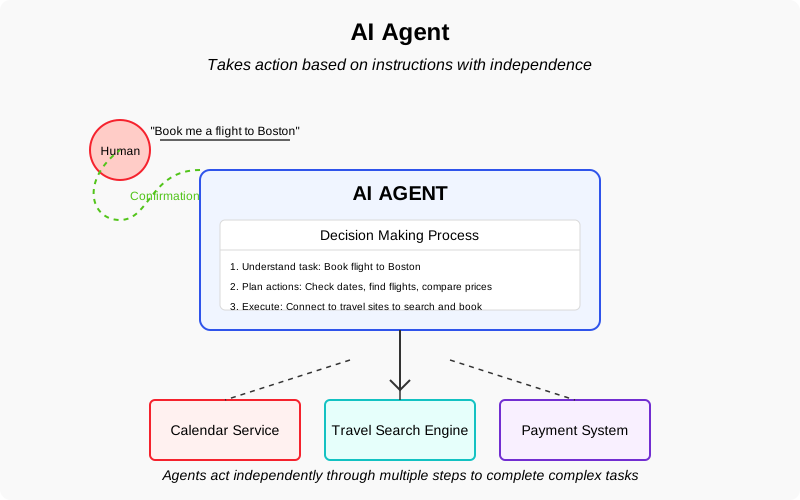
Note: This is a simplified explanation. In practice, agents can be much more complex, involving multiple layers of decision-making, state management, and interaction with various tools and APIs.
Large Language Model (LLM)
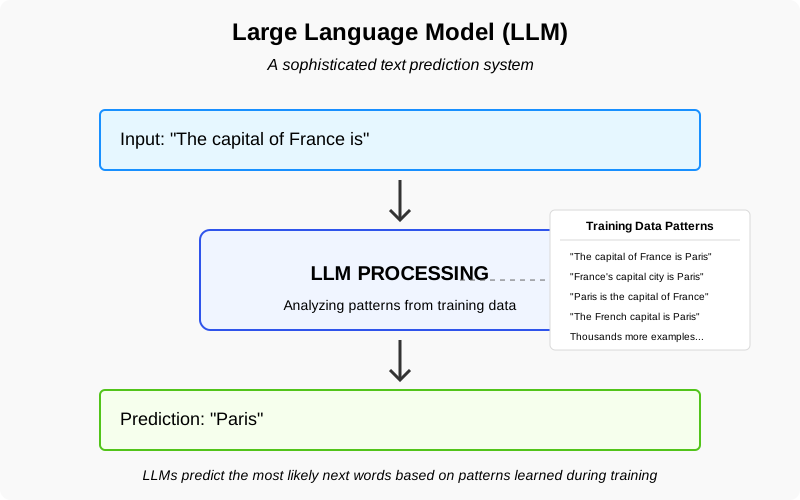
What it actually is: A sophisticated text prediction system. It’s like an extremely advanced autocomplete that predicts what text should come next based on patterns it learned from books and internet content.
Prompt Engineering
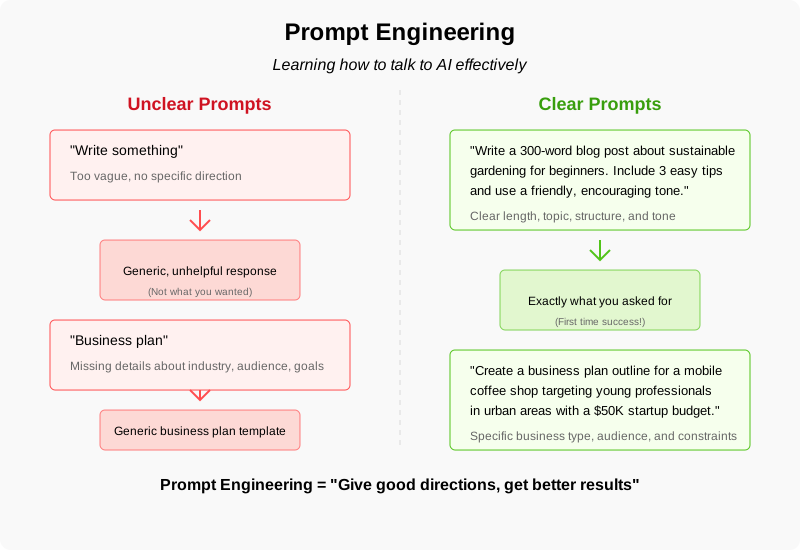
What it actually is: Simply learning how to talk to AI effectively. It’s about being clear and specific in your instructions to get the results you want—just like giving good directions to a person.
Tokens
What it actually is: The basic units that AI processes text in - roughly 3/4 of a word on average. Understanding tokens matters because they determine how much text an AI can handle at once and often affect pricing of AI services.
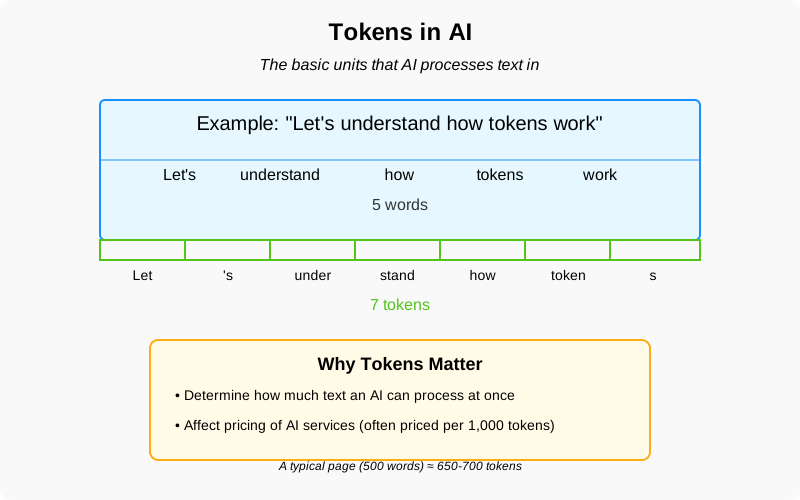
Note: An example of why understanding tokens are important:
- “Let’s understand how tokens work” = 5 words but 7 tokens
- A 1-page email (250 words) ≈ 325 tokens
- If AI services charge $10 per million tokens, sending that email to an AI costs less than half a cent
Tokens affect both how much text your AI can process and how much you pay to use it.
These terms may sound complex, but the concepts behind them are straightforward. You don’t need to understand the technical details to use AI effectively—just like you don’t need to understand how a car engine works to be a good driver.
The Great Power Shift: From Technical Skills to Problem Understanding

In the traditional technology world, building solutions required extensive technical skills. If you wanted to create a customer database, automate a process, or develop an analytics dashboard, you needed to:
- Learn programming languages
- Understand database design
- Master user interface principles
- Know how to deploy and maintain systems
This created a clear divide: those with technical skills built solutions, while those without technical skills (but with business problems to solve) had to either hire developers or settle for off-the-shelf products that didn’t quite fit their needs.
The Unexpected Opportunity
The advent of AI has given birth to an unexpected opportunity for people and society as a whole. Having worked in software engineering for my entire professional life, I can see the contours of this change happening—subtly but unmistakably. While I don’t know the exact bounds of where this evolution will take us, the direction is clear.
We’re moving toward a world where ideas can be productized much faster because, conceptually, we’re cutting out the middleman. And here, the middlemen are two significant barriers: massive platforms and development teams. We’re walking away from a developer-led economy—a techie-led economy—into a synergy where the end consumer has direct input into creation.
Because LLMs excel at understanding human natural language and have the capability to produce working code, they’re fundamentally changing the dynamics of the entire software product development lifecycle. Now, in just an hour or so, I can stand up an application by simply explaining what I want to an AI. Yes, there are limitations, and this most certainly fails for complex cases but the trajectory is there and even with today’s technology, the shift is massive and unavoidable.
Domain Knowledge Becomes the Currency
This transformation means business domain knowledge becomes more valuable than ever. Understanding the nuances of your specific business challenge is now the harder part of the equation. The person who deeply understands the problem has the advantage.
Communication skills outweigh coding skills. The ability to articulate a problem clearly and evaluate solutions effectively becomes more important than implementation details.
Focus shifts to outcomes rather than methods. Instead of debating technical approaches, conversations center on what success looks like for the end user.
Iteration cycles accelerate dramatically. When changes don’t require code, you can test ideas and refine solutions in hours instead of weeks.
Power to the Normies
I’m not saying developers are becoming obsolete—there’s certainly still a place for technical expertise. But we’re definitely moving away from a world where technocrats rule and entering one where “normies”—people with no relation to the engineering world—have a meaningful say. More importantly, they now have access to tools that can materialize their ideas and business needs at a fraction of the previous cost.
This democratization puts the subject matter expert in HR, finance, marketing, or operations—someone who previously couldn’t contribute directly to technology development—at the center of the creation process.
Technical expertise is evolving from “the ability to write code” to “the ability to architect systems where non-technical users can solve their own problems.” The greatest value comes from creating frameworks that empower others rather than building specific solutions.
For business owners and non-technical users, this represents an unprecedented opportunity to take direct control of your technology needs without waiting for IT departments or outside consultants. Your understanding of your own problems becomes your greatest asset in building solutions.
How Business Owners Can Leverage AI Without Technical Expertise
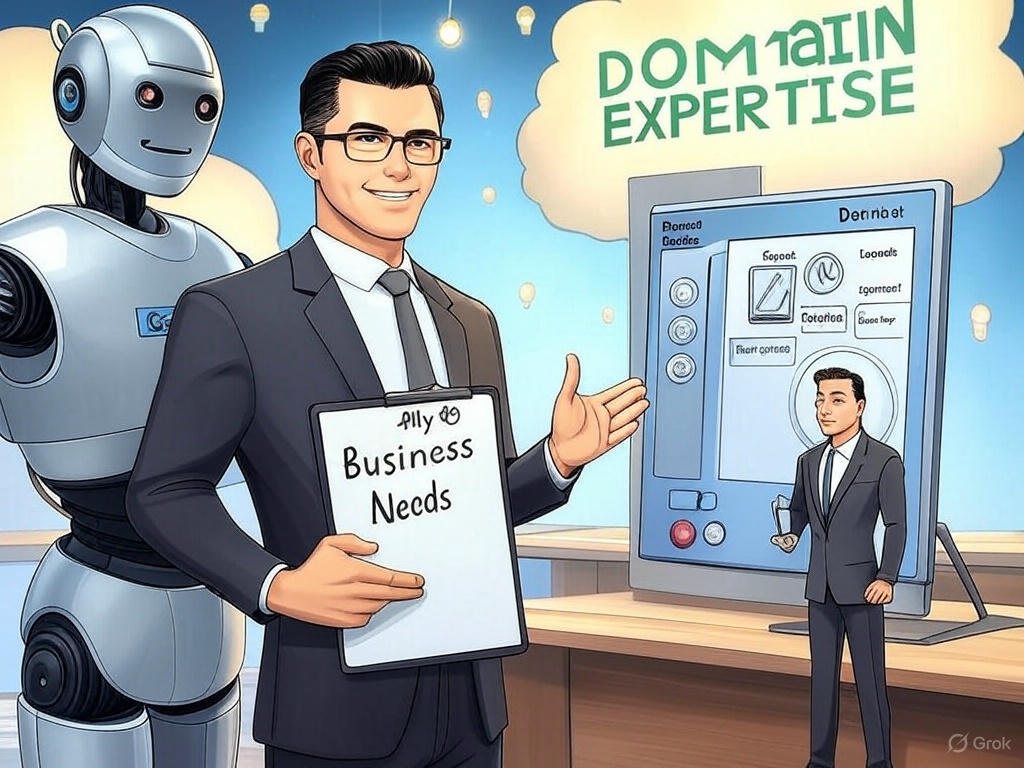
Navigating the world of AI as a non-technical business owner isn’t as straightforward as many commercials or YouTube videos might suggest. You’ve likely seen ads for AI-powered customer service chatbots, development studios, or other tools claiming to transform your business operations overnight. The reality is more nuanced.
Understanding Your Unique Business Context
No business is the same. Even companies in identical industries vary significantly in how they conduct operations. This means there’s rarely a one-size-fits-all AI solution that works perfectly out of the box. The key is defining the flows and finding tools you can adapt to your specific context without requiring technical expertise.
Ideally, you shouldn’t need to understand what compilation, deployments, testing runtimes, or any other technical jargon means. Your focus should remain on your domain expertise and business needs.
What You Should Actually Look For
As a business owner, what you really need are tools that let you:
Convert your expertise into workable AI-powered workflows - Take some input (whether natural language, files, or other formats) and produce valuable outputs.
Make changes easily - Adjust your AI implementation without calling in technical experts every time.
Understand costs upfront - This is a hidden friction point many business owners don’t realize yet. AI costs are dynamic, not static. You need transparency about what you’re paying for and the ability to make reliable cost projections.
Minimize technical overhead - While today’s development environments are impressively user-friendly, they still often require understanding concepts like file deployment, analytics, and system design decisions.
The Current Reality: A Hybrid Approach
For now, the most practical approach is likely a hybrid one. While you might not need a team of five developers, having one experienced technical person who can help bring your AI implementations into production is valuable for more customized cases.
Think of this technical partner not as the solution creator, but as an enabler who helps you implement your vision without getting bogged down in technical details. This approach represents the “synergy” mentioned earlier—combining your domain expertise with just enough technical support to make it work.
The Double Opportunity: User and Creator
Perhaps the most exciting aspect of this shift is that as a business owner or domain expert, you now have a dual economic opportunity:
Using AI to improve your business operations - Streamlining processes, enhancing customer experiences, and reducing costs.
Monetizing your domain expertise in new ways - Your specialized knowledge can be translated into something AI can understand, enhance, and potentially offer to others.
This second point represents an entirely new revenue stream that wasn’t accessible before. Your years of industry knowledge can now be packaged and scaled through AI in ways that weren’t previously possible.
Practical Applications for Your Business
1. Customer Support Enhancement
What it looks like in practice: Imagine you run a small e-commerce business selling handmade furniture. Currently, you personally answer all customer emails, which is becoming unsustainable as you grow.
AI implementation without technical expertise:
- Use a tool like ChatGPT or Claude to draft responses to common customer questions
- Create a simple knowledge base by organizing your frequently asked questions and their answers
- When new questions come in, paste them into the AI tool along with instructions like: “Based on my knowledge base below, draft a helpful response to this customer question about shipping times”
Business impact: You can handle many more customer inquiries without hiring additional staff, maintain your personal tone, and free up hours each day for other aspects of your business.
2. Content Creation and Marketing
What it looks like in practice: You’re a financial advisor who knows you should be creating regular content for your clients, but writing isn’t your strong suit and hiring a content team is beyond your budget.
AI implementation without technical expertise:
- Use AI to help outline blog posts based on your expertise
- Record yourself talking about a topic for 5 minutes, then use AI transcription and editing tools to transform your spoken thoughts into polished written content
- Create variations of the same content for different platforms (email newsletter, social media posts, etc.)
Business impact: You consistently publish valuable content that demonstrates your expertise, attract new clients through improved SEO, and build stronger relationships with existing clients—all while spending minimal time on writing.
3. Process Documentation and Training
What it looks like in practice: You run a local bakery and want to ensure consistent quality as you bring on new staff, but documenting all your processes is time-consuming.
AI implementation without technical expertise:
- Record yourself explaining each process as you perform it
- Use AI to transcribe these recordings and transform them into clear, step-by-step guides
- Have the AI suggest potential improvements or safety considerations you might have overlooked
Business impact: New employees get up to speed faster, your quality remains consistent even when you’re not present, and you discover efficiency improvements you hadn’t considered.
4. Data Analysis Without Spreadsheet Expertise
What it looks like in practice: You have years of sales data but lack the analytical skills to extract meaningful insights that could inform your business decisions.
AI implementation without technical expertise:
- Upload your data to an AI tool that accepts spreadsheets
- Ask questions in plain language: “What are my three best-selling products during winter months?” or “Which day of the week has the highest average transaction value?”
- Request visualization suggestions: “Can you create a chart showing how my monthly revenue has changed over the past two years?”
Business impact: Make data-driven decisions without needing to hire an analyst, identify trends and opportunities you might have missed, and develop a deeper understanding of your business patterns.
5. Product/Service Development Assistant
What it looks like in practice: You have an idea for a new service offering but aren’t sure how to structure it or what considerations you might be missing.
AI implementation without technical expertise:
- Describe your initial concept to an AI assistant
- Ask it to help you develop a structured service blueprint
- Request it to generate questions potential customers might have
- Use it to brainstorm potential pricing models and test assumptions
Business impact: Refine your offerings before taking them to market, identify potential obstacles early, and develop more comprehensive solutions that address actual customer needs.
Now, what do you do when you have more complex cases? Consider this scenario:
6. Personal Assistant for the Organizationally Challenged Entrepreneur
What it looks like in practice: You’re a talented professional (like an interior designer and artist) who excels in your creative domain but struggles with organizational tasks, administrative follow-ups, and structured communication.
What’s possible with AI:
- Create an integrated system that connects your calendar, email, and task management
- Set up AI-powered reminders that feel human and contextual rather than rigid notifications
- Implement auto-response generation for client/employer communications that maintain your voice but require minimal effort
- Automate the tedious administrative aspects of your business so you can focus on your creative strengths
Business impact: You remain focused on what you do best, client communications are timely and professional even when you’re in a creative flow state, and you stop losing opportunities due to organizational challenges.
Current State and Future: While these capabilities are technically possible today, implementing them requires significant technical expertise. This creates a gap between what’s possible and what’s accessible to non-technical professionals. The future of AI tools lies in making these complex integrations as simple as describing what you want to accomplish, without requiring deep technical knowledge. We need tools that can translate natural language requests into sophisticated workflows, making powerful automation accessible to everyone.
The 80/20 Principle of AI Implementation
The perfect shouldn’t be the enemy of the good when it comes to AI implementation. Even if AI solutions only work 80% of the time (or even just 20% of the time), that’s still valuable time saved that you can redirect to:
- Spending time on what matters most (spiritual growth, family, etc.)
- Making additional sales
- Focusing on creative work that generates more value
- Working on business growth rather than maintenance
Getting Started: Your First Week With AI
Getting started with AI doesn’t have to be complicated or require a complete overhaul of your business processes. Here are three straightforward ways to begin incorporating AI tools into your workflow that require minimal technical expertise:
1. Start with Personal Productivity
The easiest way to begin your AI journey is by using it to enhance your own productivity first. This allows you to experience the benefits directly without affecting your entire business operation.
How to implement:
- Sign up for a consumer-friendly AI assistant like ChatGPT, Claude, or similar
- Begin with simple tasks like drafting emails, creating meeting agendas, or summarizing information
- Experiment with prompts to understand how to communicate effectively with AI
- Document what works well and what doesn’t
- Use it as your buddy to talk to it like you would to a real person - on any topic!
Success metric: Track how much time you save each week on routine tasks. Even saving 2-3 hours weekly represents a significant ROI for a business owner.
2. Enhance One Customer-Facing Process
Once you’re comfortable using AI personally, identify a single customer-facing process that could benefit from enhancement.
How to implement:
- Choose something manageable like follow-up communications, FAQ responses, or quote/proposal generation
- Create templates that incorporate your brand voice and expertise
- Test the AI-enhanced process with a small segment of customers first
- Gather feedback and refine before expanding
Success metric: Compare customer satisfaction or response times before and after implementation. Look for specific feedback about improved responsiveness or helpfulness.
3. Audit Your Repetitive Tasks
Take inventory of tasks you and your team perform repeatedly that follow predictable patterns.
How to implement:
- Document 5-10 repetitive processes that consume significant time
- For each process, write down: How often it’s done, who does it, and estimated time spent
- Select the highest-impact item from this list to automate or enhance with AI
- Create a simple workflow that uses AI to handle 50-80% of this task
Success metric: Calculate time saved multiplied by the frequency of the task. This gives you a concrete ROI figure to justify further AI implementation.
It’s really just about the shift in your mindset.
The Getting Started Mindset
As you implement these first AI solutions, keep these principles in mind:
- Start small and specific - Don’t try to revolutionize your entire business at once
- Focus on measuring results - Define clear before-and-after metrics for each implementation
- Embrace imperfection - Remember the 80/20 principle; even partial automation creates value
- Learn through doing - Your understanding of AI’s capabilities will grow through practical application
- Build on successes - Use each small win as a stepping stone to more ambitious implementations
The most important step is simply to begin. The experience and confidence you gain from these initial implementations will naturally lead to identifying more sophisticated opportunities as you develop your “AI thinking” muscle.
Beyond Tools: The Creator Mindset
The most profound impact of AI on business owners may not be the tools themselves, but the fundamental shift in mindset they enable. Traditionally, there’s been a clear division: software companies create digital products, and business owners consume them. This division has trained many of us to think of technology as something we use rather than something we shape.
The Terminology Revolution
Even our vocabulary reveals this passive relationship with technology. We’ve been called “users” for decades—a term that implies we merely utilize what others create rather than having agency ourselves. This terminology reinforces a one-way relationship where we consume but don’t create.
As AI democratizes technology creation, we need new language that reflects this shift. We’re evolving from:
- Users → Creators
- Customers → Collaborators
- End-users → Producers
This isn’t just semantic nitpicking. The language we use shapes how we think about ourselves and our capabilities. As long as we continue to identify as “users,” we’ll approach technology with a consumer mindset. By adopting terms like “creator” or “producer,” we begin to internalize our new role in the technology ecosystem.
The Reciprocal Agency Effect
There’s a fascinating reciprocity at work here: AI tools themselves possess a form of agency—the ability to understand requests and take action—and by interacting with these tools, people gain agency of their own. The power transfers in both directions.
By using tools that have built-in capabilities to understand and execute complex tasks, regular people gain the power to accomplish what once required technical specialists. This is the democratizing effect of AI—the agency of the tool amplifies the agency of the person using it.
This means we’re not just changing what we call ourselves, but fundamentally changing what we can do. The person who was once labeled a “user” can now shape digital experiences, build workflows, and create solutions—all because they’re partnered with tools that magnify their creative intent.
Breaking the Consumer Mentality
For decades, most business owners have been conditioned to:
- Browse available software solutions
- Evaluate which ones come closest to their needs
- Make compromises to fit their processes into existing tools
- Wait for updates and hope the vendor adds requested features
This passive relationship with technology creates significant limitations. Your business is forced to adapt to tools rather than having tools adapt to your business. Your competitive advantage becomes limited by what off-the-shelf solutions can provide.
The Creator Mindset
AI fundamentally changes this dynamic. When you can describe what you want and have technology respond accordingly, you shift from being a mere consumer of technology to becoming its co-creator. This shift has several important dimensions:
1. From “What’s available?” to “What do I need?”
Instead of starting with available solutions, you begin with your unique business requirements. The question changes from “Which existing product comes closest to what I need?” to “What exactly would the perfect solution for my business look like?”
2. From feature requests to direct implementation
Rather than submitting feature requests to vendors and hoping they’ll be implemented someday, you can often create customizations yourself through AI interfaces. This direct agency over your tools creates unprecedented flexibility.
3. From standardization to personalization
Mass-produced software necessarily aims for the middle of the market. As a creator, you can build solutions that precisely match your unique business context, creating potential competitive advantages through technology that works exactly how you need it to.
4. From passive consumption to active experimentation
The creator mindset embraces continuous improvement. When making changes is simple, you’re more likely to experiment, refine, and evolve your tools over time. This creates a virtuous cycle of ongoing optimization.
The Simplified Interface Revolution
Another transformative aspect of this shift is how AI fundamentally changes what we need from user interfaces. Traditional software required complex user experiences with numerous buttons, menus, and specific workflows to accomplish tasks. These interfaces had to be meticulously designed to guide users through multi-step processes: selecting files, specifying locations, applying transformations, and so on.
With AI as an intermediary, these complex interfaces can be dramatically simplified or even eliminated entirely. Instead of navigating through a series of screens to accomplish a task, you can simply describe what you want:
- Instead of: “Click upload button → Browse files → Select file → Choose destination → Click transform button → Select transformation type → Apply → Save”
- Now: “Take my latest sales report and create a summary dashboard with the key metrics”
The AI understands the context of your work, can identify the relevant files based on your description, knows what transformations would be appropriate, and can execute the entire workflow through a simple conversation.
This simplification has profound implications:
- Reduced learning curves - New tools no longer require extensive training to master their interfaces
- Faster implementation - Applications can be built in a fraction of the time when complex UX design is no longer necessary
- Focus on outcomes rather than steps - People can think about what they want to accomplish rather than how to navigate a system
- Contextual awareness - AI can maintain awareness of your recent activities, making interactions more natural
For creators and businesses building tools, this means significantly reduced development time and complexity. The intricate user experiences that once required months of design and testing can now be replaced with conversation-based interfaces that are both more powerful and simpler to create.
This is yet another way AI shifts power to the creator—building useful tools becomes accessible to those without UX design expertise, further democratizing who can participate in technology creation.
Becoming Comfortable with Creation
For many business owners, this mindset shift can feel uncomfortable at first. If you’ve never thought of yourself as someone who can create technology, it may seem like unfamiliar territory. Here are some ways to embrace this new role:
Start by modifying rather than creating from scratch: Take existing templates or basic tools and adapt them to your needs before attempting to build something entirely new.
Celebrate small successes: Even minor customizations that save you time or improve results are victories worth acknowledging.
Build your prompt literacy: Learn how to communicate effectively with AI by understanding what types of instructions yield the best results.
Develop a “possibility mindset”: When facing business challenges, ask “Could AI help with this?” before assuming you need to handle it manually.
Conclusion: Embracing the AI-Powered Future
The Unprecedented Pace of Change
As we wrap up this exploration of AI/EI for business owners and “normies,” it’s worth acknowledging something extraordinary: the pace of change in this industry is unlike anything we’ve seen before. In my professional experience, I’ve never witnessed anything comparable to the current cadence of new models, tools, theories, and applications emerging in the AI space.
This acceleration shows no signs of slowing. If anything, it will likely continue to intensify until it reaches some natural convergence point —whether that’s bounded by hardware limitations, the laws of physics, or mathematical constraints. We’re nowhere near that point yet, which means we’re living through a period of profound and rapid transformation.
While predicting specifics about the future is challenging, one thing is certain: those who approach this revolution with curiosity and adaptability will thrive, while those clinging to the status quo of traditional technology development will increasingly find themselves left behind.
Practitioners, Not Philosophers
Throughout this post, I’ve emphasized practical applications over philosophical debate. Conversations about AI consciousness might be intellectually stimulating, but they often distract from the more immediate question: how can this technology solve real problems today?
We are practitioners. Our focus is on learning how to use these tools effectively to automate mundane tasks, enhance productivity, and achieve more in less time. I’ve experienced this firsthand in my day job—AI has dramatically increased my productivity, allowing me to accomplish in hours what previously took days.
This practitioner mindset is crucial. We don’t need to wait for perfect understanding before we start using and benefiting from these tools. By actively engaging with AI, we develop an intuitive sense of its capabilities and limitations that no amount of theoretical knowledge can provide.
The Creator Economy
As we’ve explored throughout this post, the most significant shift may be how AI transforms who creates technology. The traditional boundaries between platforms, developers, and users are dissolving, creating unprecedented opportunities for those who understand this new paradigm.
By embracing your role as a creator rather than a mere user, you position yourself at the forefront of this transformation. The business advantages will go to those who can leverage AI to rapidly implement their domain expertise into functioning systems—without waiting for traditional development cycles.
Join the Conversation
The journey of exploring and implementing AI isn’t just about business—it’s about how this technology can enhance various aspects of our lives. I’d love to hear about your experiences:
Share Your Experience: What role do you see AI playing in your world? Take a moment to share your thoughts in our quick survey about:
- How AI has already made a positive impact in your personal or professional life
- What daily task or challenge you wish AI could help solve for you
- Your biggest question or concern about incorporating AI into your routine
[AI Implementation Survey Link]
Your insights will help shape future content in this series and connect you with others exploring similar possibilities. Whether you’re looking to transform your business operations, streamline personal projects, or simply understand this technology better, your perspective matters.
Let’s learn and grow together in this rapidly evolving landscape of AI!